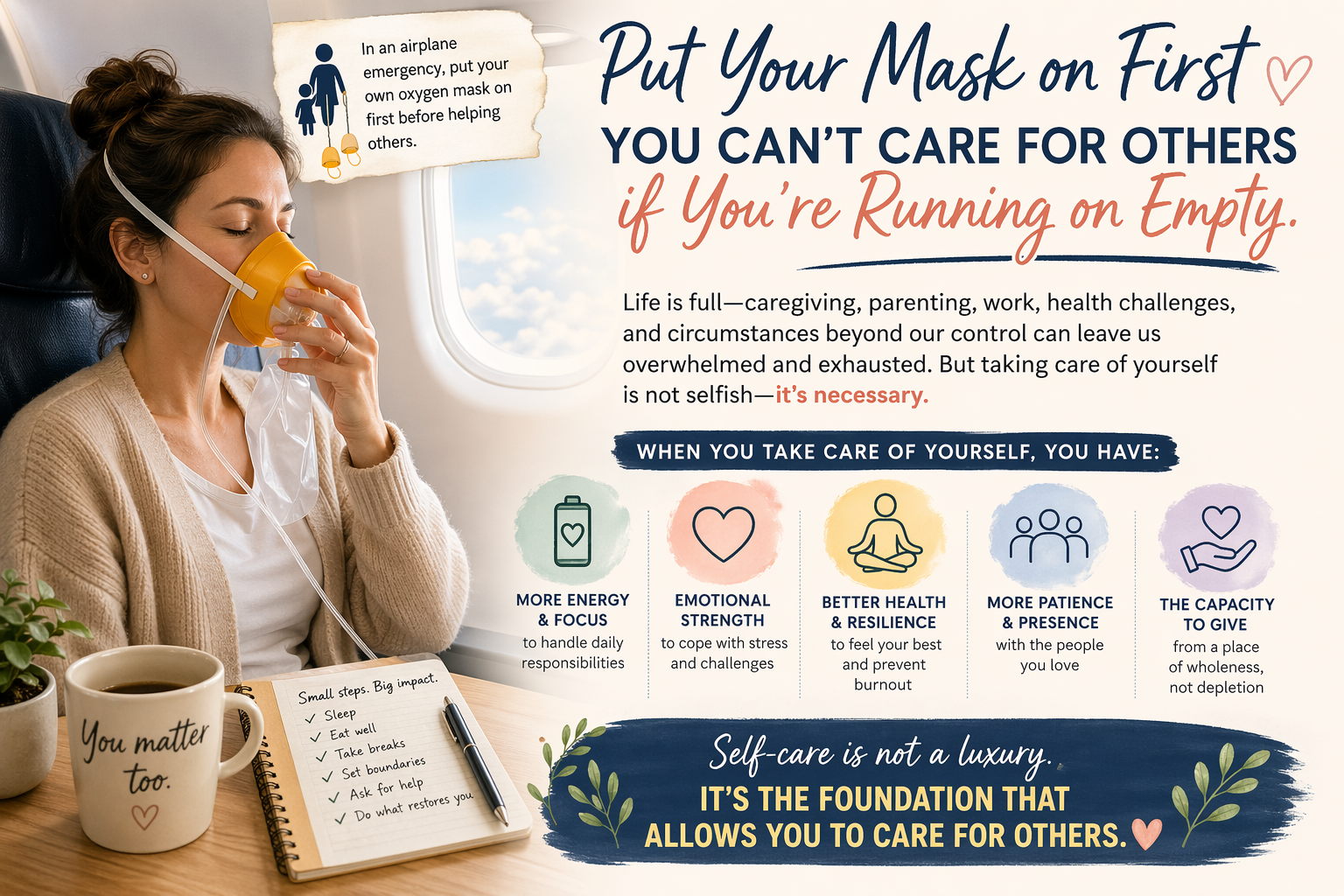
Put Your Oxygen Mask on First: Why Caring for Yourself Is Not Optional
On every airplane, there’s a moment during the safety briefing that tends to get overlooked: put your own oxygen mask on before helping others. It can feel counterintuitive—especially for parents, caregivers, and people used to putting others first. But that instruction reflects a fundamental truth: if you are depleted, overwhelmed, or unwell, your ability to care for anyone else is compromised.
The Reality of Modern Life
For many people, daily life is not just busy—it’s layered with responsibility. Caring for children, supporting aging parents, managing a career, navigating financial pressures, or dealing with personal health challenges can create a constant sense of urgency. On top of that, there are circumstances outside your control—unexpected illness, loss, or instability—that can make life feel unmanageable at times.
In that environment, self-care often becomes the first thing to disappear. It can feel indulgent or impractical to prioritize your own needs when others depend on you. But neglecting yourself doesn’t create more capacity—it quietly erodes it.
What Happens When You Don’t Take Care of Yourself
Ignoring your own physical and mental needs doesn’t just affect you; it has a ripple effect:
- Reduced energy and focus, making everyday tasks harder
- Emotional fatigue, leading to irritability or burnout
- Declining health, which can limit your ability to show up for others
- Less patience and presence, even with the people you care about most
Over time, running on empty becomes unsustainable.
Reframing Self-Care
Self-care is often misunderstood as something time-consuming or luxurious. In reality, it is about maintaining your baseline—ensuring you have the physical, emotional, and mental capacity to function well.
It includes:
- Getting adequate sleep
- Eating consistently and nutritiously
- Taking short breaks to reset
- Setting limits when demands exceed your capacity
- Seeking medical care or support when needed
- Allowing yourself moments of rest without guilt
These are not extras; they are maintenance.
Why It Feels So Difficult
Even when people understand the importance of self-care, acting on it can be challenging. Common barriers include:
- Guilt: feeling like time spent on yourself takes away from others
- Time constraints: believing there is simply no room in the day
- Habit: being conditioned to prioritize others first
- Overwhelm: not knowing where to start
Acknowledging these barriers is important, but they do not eliminate the need for change.
A Practical Approach
Taking care of yourself does not require a complete life overhaul. Small, consistent actions are more effective than occasional large efforts.
- Start with one non-negotiable habit (e.g., a consistent bedtime or a 10-minute walk)
- Build brief pauses into your day rather than waiting for long breaks
- Identify what actually restores you, not just what fills time
- Accept that doing everything is not possible, and prioritize accordingly
The Impact on Others
When you are more rested, stable, and supported, the quality of care you provide improves. You are more present, more patient, and better able to handle challenges. Taking care of yourself is not separate from caring for others—it directly strengthens it.
The Bottom Line
Life will continue to present demands, and many of them are unavoidable. But your well-being is not optional within that equation. It is the foundation that allows everything else to function.
Putting your “oxygen mask” on first is not selfish—it is necessary.
What is Your Brain Worth?
Register for the concussion workshop now, and learn how to protect your brain!
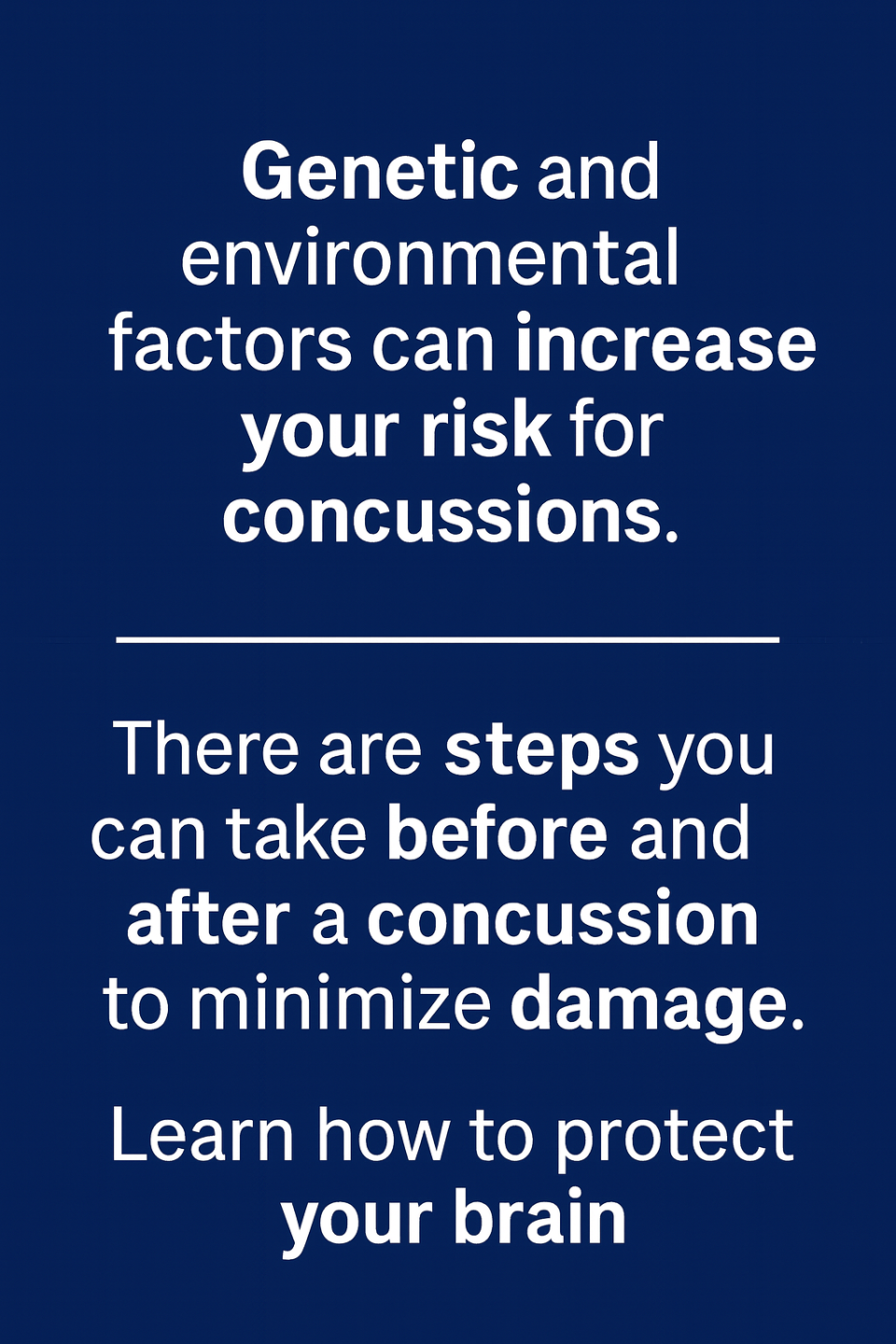
Which Genes Increase Concussion Risk & What You Need to Do to Protect Your Brain?
In the concussion workshop, I go in depth into the specific genes that can increase your risk of concussions and influence how well your brain recovers after an injury. By understanding these genes, you’ll learn why some people are more vulnerable to concussions than others—and more importantly, what targeted steps you can take to support your brain, reduce your risk, and optimize healing. You can order a Genetic Detoxification report to get your genotype.


If you want access to all three classes, including recordings you can revisit anytime, you can enroll in the full course.
Use coupon code:
LASTCHANCE
for 50% off enrollment.
All sessions are recorded and available upon purchase, so you can watch (or rewatch) at your convenience.
If you’ve been searching for why recovery has stalled — for yourself or your patients — this may be the missing link.